Flying Birdman & telematics
Flying Birdman
a brief history of our involvement in telematics and online performance
From 1999 to 2003 Johannes Birringer created and headed the Dance & Technology MFA program at The Ohio State University while forming the „Environments Laboratory,” a transdisciplinary studio for digital performance technologies, including real-time digital signal processing, telepresence, and motion capture.
The annual lab cycle was attended by students from the college of the arts and by guest artists from the Netherlands, Brazil, India and Australia. The laboratory produced several interactive dance installations; e.g. “ghost island” (2001, Intermediale Festival in Mainz, Germany); “Embers” (2002, Power Center for the Arts in Ann Arbor, Michigan). Birringer initiated the IPS (Interactive Performance) Series at Ohio State University and curated several international workshops on art and technology, conferences, and multimedia concerts. In November 2002 he directed the multi-site online performance „Flying Birdman,“ which linked five sites in the US and two sites in Brazil.
He is a founding member of ADaPT (Association of Dance and Performance Telematics), and has served on the Board of Directors of IDAT (International Dance and Technology). In 2003 he founded the international Interaktionslabor Göttelborn in a former coal mine in Germany, initiating long-term research into interactive systems, emergent technologies and digital art. This independent laboratory celebrated its tenth anniversary in 2013. From 2003-2006, he was Visiting Principal Research Fellow at Nottingham Trent University, School of Art and Design, where he created the Telematics DAP-Lab (LaTeLA) as a node of the international ADaPT network.
+ + +
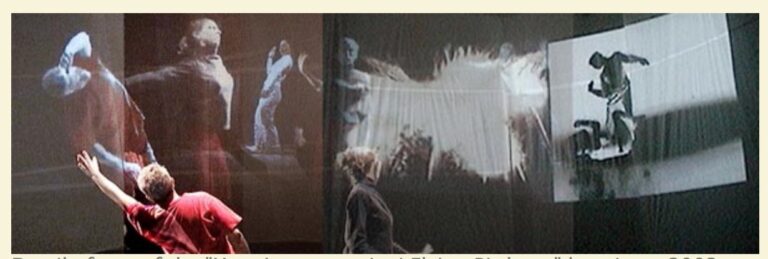
HERE I COME AGAIN
(FLYING BIRDMAN)
November 25
Adapt: Monday Night Live – 6 pm EST
a telematic earthwork linking 7 remote sites/non-sites
Quicktime 6 (URL): rtsp://128.146.187.3/osu
More background on the performance script:
Reflections on the „Flying Birdman“ multi-site telematic earthwork:
OSU Birdman Team in pre-productions
Marlon Barrios-Solano, Eric Camper, Jean Haluska, So-Yeon Park, Amita Nijhawan, Ed Luna,Lali Krotoszynski (guest, Sao Paulo, Brazil), Kelly Gottesman, Ran Berdichesky, Sylvana Christopher
directed by Johannes Birringer
+ + +
Performance script for ADAPT / Monday Night Live, Monday, Nov. 25 – public online performance, 6:oo pm EST
Participating Performance-Teams:
OSU: Johannes Birringer, Mike Kaylor, Ashley Friend, Hyunjung Chae, Michelle Stortz, Maartje Janssen, Karen Soto, John Jay, Ching-Fang J Chiang,
UU: Ellen Bromberg, Jimmy Miklavcic, Brian Buck, Joe Breen, Julio Facelli, Juan Adalpe, Michiru Onizuka-Kempen, Mia Provenzano, Jersey Reo Riemo.
ASU: John D. Mitchell, James Casey, Casey Blake, Meredith Koloski, Apryl Seech, Siew Wong.
UW: Gray Taylor Miller, Chris Dowling, Christine Olson, Alison Rootberg, Mary Moran,Emily Plotkin.
UNB/ Corpos Informáticos Research Group: Maria Beatriz de Medeiros, Carla Rocha, Viviane Barros, Cyntia Carla, Cila MacDowell, Maria Luiza Fragoso, Renato Cohen (Sao Paulo)
WSU: Kelly Gottesman; Laura Geldys, Kamilah Davis, Anh Nguyen, Joel Sunman, Bill Meyers, Gary Cendrowski, Michelle Gottesman
Streaming Configurations in the sites (transmitting / receiving)
(Studio Designs have to be coordinated) : OSU studio redesign / WSU studio (to match cameras and transmissions)
http://www.dance.osu.edu/~jbirringer/Dance_and_Technology/enXadapt.html (website may no longer exist)
Performance Script / Content-Structure
Description:
COLLABORATIVE TELEPRESENCE PROJECT
„Here I come again“ (Flying Birdman, Spiral Jetty)
(mixed media: video/audio streams, still images, voices, graphics/text)
length: approx. 60 minutes/real-time synchronous
participating sites (five): Ohio, Arizona, Utah, Wisconsin, Brazil
Performance: Monday, November 25, 6:oo EST
CONTENT – STRUCTURE *
„Here I come again“ is a telematic „earthwork“ based on narratives/dreams and structured spirally as a „Renga“ (linked poem) composed of precorded filmic images; still images, drawings, camera-generated movement-images; real-time audio and sound processing, and both spoken voice and graphic text that is written on by participants continuously during the live performance.
The performances delves into the theme of „left overs,“ debris and returns, as well as the idea that what is returned needs to be transported from one site to another. The anchoring voice of the Flying Birdman runs through the entire telematic performance („Here I come again“), but this voice of the Birdman is also under-scored with subtle audio mixes and other traveling and whispering voices that function like echoes or reverberations of single words. These words can be chosen by the participating performers, picked up and digitally transformed by the other collaborating site partners. The run-on voice of the Birdman will be performed by all five sites, while we are watching video streams (from one site), movement images (from another), still images (from another), drawing and textual graphics (from another). We also anticipate that the Birdman’s voice changes and transforms (from one language to an other).
Each partner site experiments with panoramic screen (with many windows open at the same time) or surround screen allowing for the performers/participants to see all sites dialogue with each other in a spiral, rather than having all streams mixed down to one multicast. This allows local live audiences to see all sites in parallel realtime (in the renga-like spiral of scenes), while also having the option of watching a mixed/composite screen (UW will experiment with mixing).
The dramaturgy for this telematic „earthwork“ envisions a spiralling dialogue /communication – between sites and non-sites- , with at least 2 sites dialoguing with each other (video, audio) at a given time during the 10 scenes, and then the dialogue is passed on, as in the Renga form of a linked poem.
To ensure direct inter-action (call & response) between the sites, we suggest that in the second round of the performance (scene 6 – 10), we begin to let the camera-generating site (live video stream) initiate a movement phrase that is „passed“ between interacting partners, and we see movement becoming interlinked. The passing on of a movement phrase need not be imitative, but each performers who sees a movement gesture tries to develop it. In this evolving interchange, we again want to work with the theme of „left over,“ movement debris, degraded images…….and what happens to a movement when it comes back after someone has seen/interpreted/re-behaved it.
We hope to see the Brazilian site on the same speed (video/audio), or we will work with their iVisit connection to incorporate text and graphics/drawings into a „graphic language“ that is passed between. If one site is slower, we seek to integrate their existence, not overlook it.
The construction of this telematic script is derived from a composite architecture of different textual, image, and movement motifs.**
Narrative layers are based on a continuous/spiralling text (with 10 scenes ). Each SCENE will last a total of 6 minutes, which means we have time to carefully experience video streams, movement, resonances of voice,