environments 2
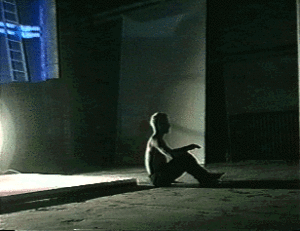
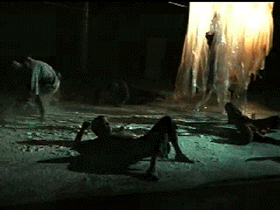
environments 2
Multimedia Workshop by Johannes Birringer
For bookings write to orpheus (at) rice.edu
E n v i r o n m e n t s
WORKSHOP ON INTERACTIVE ENVIRONMENTS
PROPOSAL FOR ISEA 2000
This multimedia presentation is designed to raise pertinent programmatic questions concerning the new „SPACE“ of research/teaching in the field of dance technologies and interface design. The workshop participants will explore transformations of the traditional rehearsal studio.
We wish to share with other artists/teachers our experience as an independent media performance group and a research lab in dance technologies experimenting with new concepts for:
1) for a multimedia studio or „intelligent space“ necessary for integrated, process and production oriented work in dance technologies
2) for long-term processual research in „ENVIRONMENTS“ allowing dancers and students from the related arts to investigate the implications of digital multimedia and interactive-design parameters.
3) for experimentation with the new „plasticity“ of electronic sculptures and nervous environments partly designed for performer and audience interaction, and for „conversion“ (site-transitions to the internet, telematic events, websites). This experimentation involves architectural diagram concepts of „anteriority,“ „interiority,“ and „exteriortity“ adopted from Peter Eisenman. Our lab ensemble in Columbus works on the continuing design of a performance website, „The Fold“, (at the Wexner Center for the Arts built by Eisenmann). In the ISEA workshop we will create scenographic and choreographic parameters including interactions with digital cameras and interface devices, capture the scene and explore its transference to an interactive web-design.
„Body – Art & Technological Transformations“
a workshop directed by Johannes Birringer
This workshop is a component of a longer research cycle, „Environments,“ which was originated at Ohio State University’s Dance &Technology Program in 1999. It has evolved through 12 phases; the touring concept is explained below.
Environments
The lab workshop on „Environments“ has been offered at dance festivals and conferences since 1999
Workshop Method: 2 or 3 hour lab
Introduction: „designing a laboratory for movement technologies“
00 – 45. min Introducing designs and diagrams (film/website excerpts from my work, practical issues)
45.- 65.min space for discussion & exchange; transforming the studio
65.-120.min physical experimentation, tests with camera interfaces, sensors, and digital tools
120.-180 min feedback, analysis of digital data captured during test; projections, uplinks.
Participants will physically experience and intimate the propositions for new environments and explore the question of training/composing with new digital tools and sculptural/architectural ideas for experimentation in installation and interactive environments.
Environment LAB concept:
The lab creates a space for research, locating ourselves in the larger contemporary contexts of experimentation with digital media, designing such spaces of experimentation, and navigating/moving in them.
We think through all the dimensions of „e n v i r o n m e n t“, how it affects dance, how dance affects environment, how dance interacts, how environments interact, how we perform within sensitive and responsive environments (architectures, interfaces, objects, textures, light, sound, silence, projections), how we integrate spatial, acoustic and imagistic media into our movement senses, how movement converges with digital information and vice versa.
We explore integrated methods & improvisations with these spaces and relations, create our own interactive process-method and theory of such compositional process.
The workshop includes a demonstration of the possible transformations of a „rehearsal“ studio into a digitally enhanced, plastic environment for interactive experiments (movement, voice, sound, light, projection, sensitive/motion tracking devices, feedback systems)
Technical requirements:
1. Space: blackbox studio, rehearsal space, industrial site, gallery or theatre
2. Two video projectors (LCD) with sound system for audio (amp, mixer, speakers), one white wall or white scrims. Flexible construction elements, risers, wood, etc. Additional small external speakers for computer/audio. One VCR (VHS) Two G4 Macintosh desktop computers with Firewire in/out.
3. Internet access (dedicated line or Ethernet connection to server)
4. Flexible Lights (dimmer board)
5. One or two digital camera(s), tripods
Presenter will bring Mac G3 laptops, 1 digital camera, videotapes, software, cables