a thousand machines
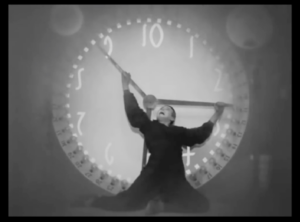

a thousand machines
film installation, with live music
Johannes Birringer (film)
Paulo C. Chagas (music)
2017
Performed at University of California-Riverside
A film inspired by Fritz Lang’s ‘Metropolis’ (1927) recomposited 2008 after lost footage was rediscovered in Buenos Aires; in addition, inspired by Gerald Raunig’s ‘Concise Philosophy of the Machine as Social Movement’ (2010); Karl Marx – ‘Fragments on Machines’; and Vsevelod Meyerhold’s biomechanics.
Music by Paulo C. Chagas.
Postproduction by Johannes Birringer & Paulo C. Chagas. Sound remix (with 1957 Sputnik audio signal) by Johannes Birringer; biomechanics performance by Johannes Birringer (camera: Renpei Geng; editing of biomechanics: Sara. S. Belle. Audiovisual remix & editing: Johannes Birringer. Epilog: (dancer in the mist) Min Tanaka fog sculpture by Fujiko Nakaya, captured at Tate Modern, London. (c) 2017
DAP-Lab /Shadows of the Dawn Productions
Description
„Wer seine Laster besiegen will, muss seinen Lastern nachgehen“
[Oscar Wilde]
A troubled yet famous classic masterpiece of the silent film era – Fritz Lang’s futurist Metropolis (1927) – provides the catalyst for this contemporary revisiting of machinic modernism. Both deeply ironic as well as melancholic in nature, this short audiovisual remix is ultimately disturbing, in its quiet commentary on the delusions of “workers leaving the factory” (the title of the earliest cinematic moments of Lumière). There is no exit. Chagas’s piano music is haunting and spectral, descending into a furiously imagined loneliness.
The workers in Birringer’s a thousand machines are shrouded in mist and fog, the darker atmosphere of the industrial underworld depicted in Lang’s curiously patronizing ideological filmic mess of a failed communal uprising against Capital. The uprising drowns, ending in a pathetic scene of reconciliation – between capital and labor – in this grand dystopian city of future and present class tensions. The workers in a thousand machines are not robots, however, but “brothers” who exchange places (one briefly escapes into the Yoshiwara pleasure club, alluded to by Oscar Wilde’s epitaph) and move fluidly in the sense of Meyerhold’s biomechanics. They are also actors.
Thus, they are dancers and workers in a museum of cinema (Lang’s original version was 153 minutes long, released in a drastically cut version by UFA and Paramount; lost footage was only recently rediscovered in Argentina in 2008; Soviet and East German archives also had recovered some missing scenes and restored them in 1972). This museum is troubled and broken up, as the restored version now allows a fuller critique of the original film’s völkisch and fascist resonances, and Lang’s megalomania.
This treatment in a thousand machines does not so much undermine the Wagnerian tones of Lang’s film which features a Parsifal-like mediator, the son of the capitalist leader, nor delve into Rotwang’s engineering of the erotic robo-Maria, but focuses on the Heart Machine, the perverse clock that seems to control the city’s electrical supply. The city breathes with an electronically augmented soundtrack of whispers, spacecraft radio signals, distorted speech sounds, lost fragments from science-fiction – slowly becoming immersed in the musician’s strokes, a liminal piano music that makes this audio-visual composition by Paulo C. Chagas and Johannes Birringer drift off from any idealistic ending. All associations with the mass ornaments of machine modernism and the architectures of the triumph of the will dissolve in the concluding misty vapor, where Japanese butoh dancer Min Tanaka stands alone, an unaccommodated body in midst of an alienating built environment (today’s London).
Live installations:
2017 Culver Center, University of California, Riverside, USA;
2017 Arts&Artaud, Artaud Performance Center, London;
2024 „Silence is a Canvas: Nosferatu: Absent Presences and Digital Cultures“ Symposium & Concert, Organizers: Paulo C. Chagas | Nikolay Maslov | Christophe Katrib June 8, UCR ARTS, California Museum of Photography
2025 concert-film, music by Paulo C. Chagas, performed as Brazilian premiere, during 9th Encontro Internacional Piano Contemporâneo
This performance/film/concert project represents the third film-concert collaboration between composer Paulo C. Chagas and media choreographer Johannes Birringer. Their first digital oratorio, Corpo, Carne e Espírito, had its world premiere at the Klauss Vianna Theatre, Belo Horizonte, Brasil during the FIT-BH Festival 2008. Sisyphus of the Ear, a silent film for live percussion and electronic music, premiered in Ufa (Bashkir) at the Bashkir Philharmonic Society in October 2016, and went on tour in 2016-17.