books/releases2: CDs
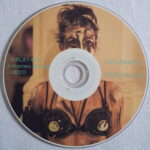
CD RELEASE 1998
North by South
a digital film-music concert: Music in Modules by Steve Paré and Patrick Clark
based on the live performance by AlienNation Co, first produced at Diverse Works, Houston, 1998.
The CD includes CD ROM files with digital video and photographs by Patrick Clarke and Steve Paré.
Performance Music Titles:
ECG / The Heart / Knot / Dream Text 1 / River / El Finge / Ephitalamium / Intimacy / Interferences / Interferences II / Dream Text II / Reversal / The Garden of Childhood Memory
(c) 1998 Sales Price: $ 9.99 (plus shipping) // order from: orpheus (at) rice.edu
exhibition DVD 2003
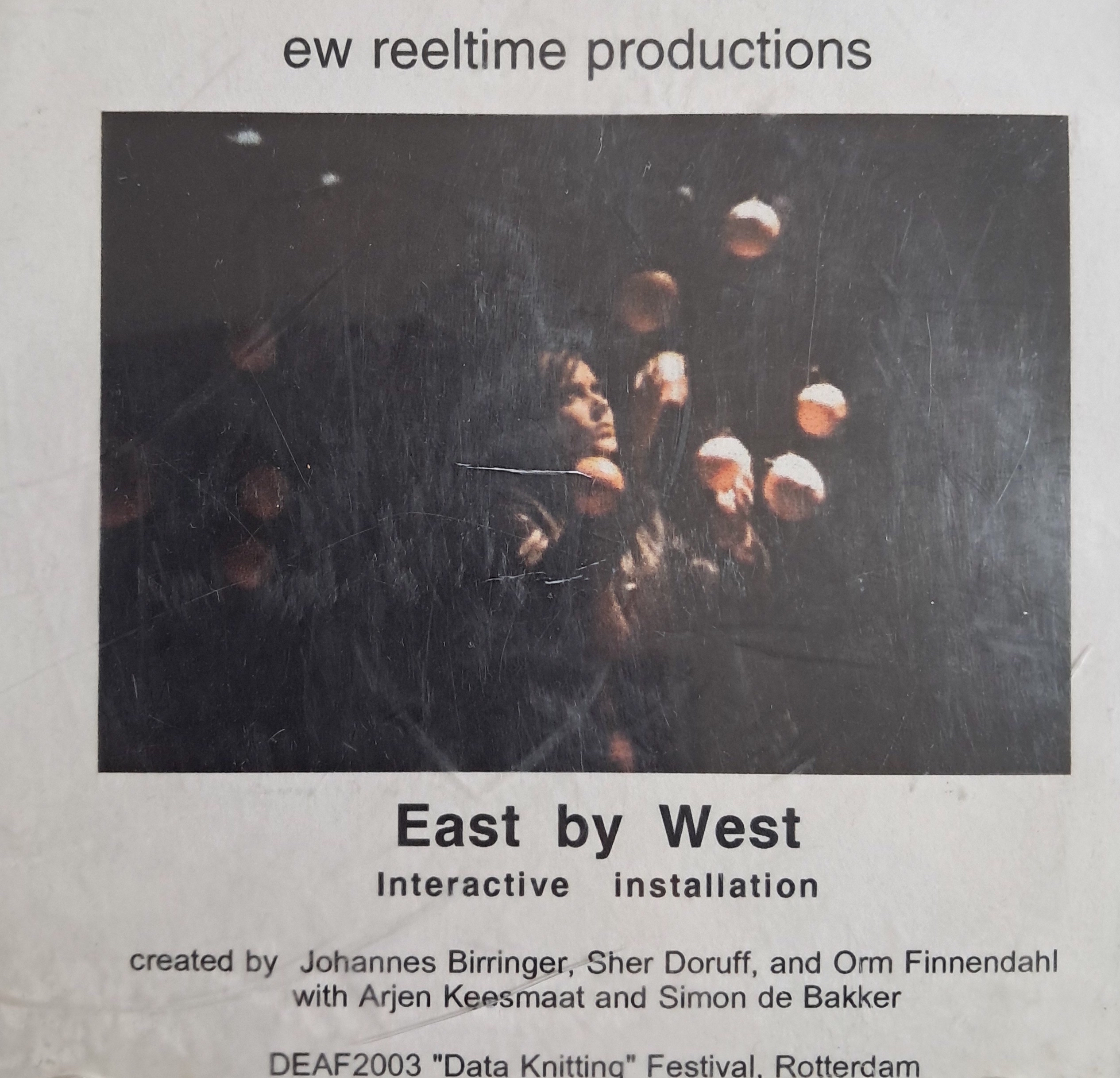
East by West, networked interactive installation, new version created with Sher Doruff, Orm Finnendahl, and Arjen Kersmaat. DEAF/V2 Festival, Pakhuis Rotterdam, The Netherlands
film DVD 2004
Xu, Film exhibition, DVD, Media Lab, Beijing Dance Academy, China.
directed by Johannes Birringer. Featuring dancer/choreographer Wan Su.

4 DVD Releases of Performances;
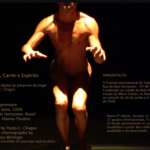
- Corpo, Carne e Espírito, DVD, digital oratorio, world premiere FIT-BH Festival, Klauss Vianna Theatre, Belo Horizonte, Brasil.
- Suna no Onna, DVD, interactive dance exhibition, Watermans Art Centre, London.
Ukiyo 2 (Moveable Worlds), Photo-DVD, choreographic installation, KIBLA Media Arts Center, Maribor, Slovenia.
- Ephemeral Edgespace (metakimosphere no. 6), DVD, dance performance-installation, with Haein Song and Claudia Robles Angel, ISEA 2018, Durban City Hall, Durban, South Africa
For further inquiries and orders on book, video and audio releases, contact:
orpheus (at) rice.edu
„Contemporary Performance/Technology“
An essay by Johannes Birringer
Theatre Journal 51.4 (1999) 361-381
pp. 379-80, a brief citation:
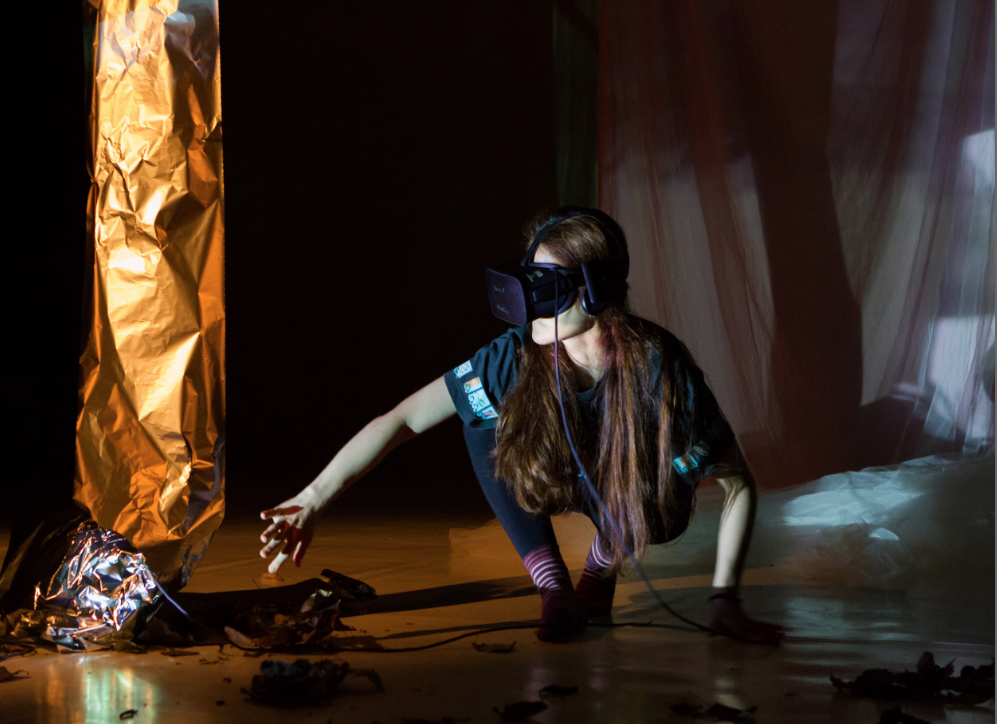
My ideas for „Lively Bodies Lively Machines“ (LBLM), the workshop I teach every summer, evolved from this thinking about deep contact between organic and non-organic surfaces or projections.14 A decisive issue in our thinking about technology and choreography is the question of commensurability. In this regard, Theodores quoted Kozel’s prediction that „if technology is regarded as abstract, logical and mechanical and bodies are seen as organic matter only, then the two will be mutually hostile. But if technology and bodies are seen additionally in terms of flows of energy or intensity or as fluid dynamics, then there is ground for collaboration.“ If indeed the technology in our performance experiments was driven by the experience of the body itself, then knowledge of the body and its silent languages can inform ways of connecting with non-phenomenological structures in digital art. Or it can influence visual or sonic digital environments in such a way that they transmit information sensually or heighten the physicality experienced in the electronic interface, as it is the case in Rokeby’s „very nervous systems“ (interactive sound installations) or in Pamela Z and Laetitia Sonami’s work with DataGloves or DataSuits and multiple controllers, where the spatial sound events triggered by persons moving inside the interface can create a phantasmatic aura and affect their acoustic behavior, both inside the space and after leaving it.
SUEÑO de ÁNGELES ROMERO:
Una recreación multi-artística de la vida de Sor Juana
An essay by Verónica Grossi
Pontificia Universidad Javeriana, Bogotá, Colombia
Abstract:
This essay forms part of a larger project in which I investigate the role that the body plays in the works by Sor Juana Inés de la Cruz, in particular, in the epistemology that her different writings in verse and in prose construct.
In this project, I seek to reconceptualize the body, based on the philosophical premises of feminists such as Elizabeth Grosz, who question and seek to overcome conceptual binaries and their patriarcal and colonialist associations, such as body and mind; matter and reason; form and idea, that have been the foundation of Western philosophy from its inception.
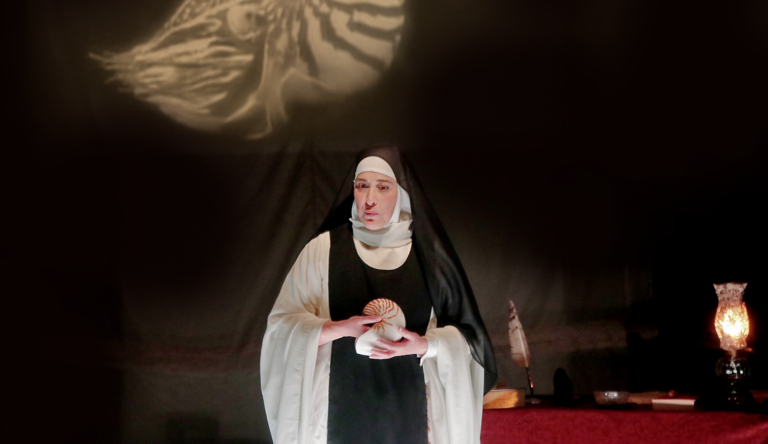
The concentration on the biograhical body of the Mexican nun by critics throughout the centuries has paradoxically left unattended the central role that the body, desire and imagination—thought, daydreams and dreams—, in its unstoppable temporal movement as well as in its heterogeneity and dispersion, has had on Sor Juana’s epistemology. The script and multimedia representation by Ángeles Romero uses the body as an expression of the complexity and plurality that characterize Sor Juana’s writing. During the theatrical representation, the body, with its voices and silences, its gestures and movements, its interactions with music, the sequence of images projected onto the screen, the scenography, the play of lights and shadows, becomes a complex, diversified emblem, a dynamic symbol or enigma open to a variety of participations and interpretations. In this way, the performance by Romero brings to centerstage the bodily discourses and practices in Sor Juana’s works.