Puntos de fuga
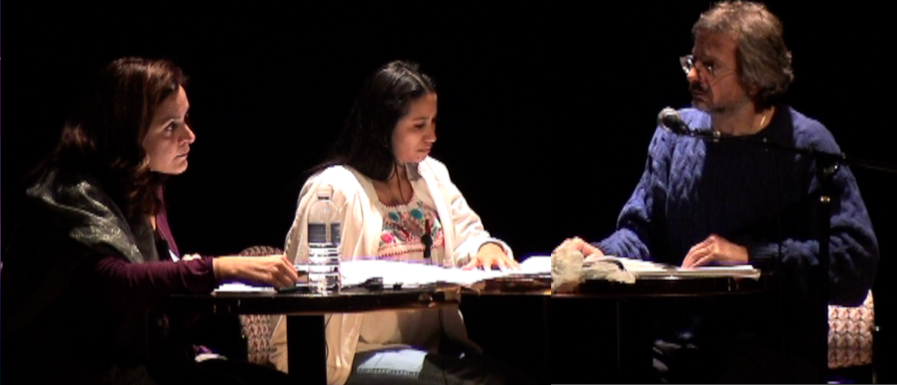
Puntos de fuga
Puntos de fuga (Vanishing Points) is a full length interactive multimedia play set in an interrogation room where Amalia, a young maquila worker from Catemaco, Veracruz is being held for questioning in connection with the kidnapping of DEA Agent John Arenas. As the officer sets off to find incriminating evidence that links her to the drug cartel, Amalia reveals her supernatural powers as a means to keep a solemn vow of securing an American airplane (piloted by the fictional character of Amelia Erahart) in order to unearth the missing women in Juárez. The interrogation is existentially challenging to the interpreter, who is discomforted by its senseless brutality.
Written by Angeles Romero.
First stage reading, December 2008, Talento Bilingue Theatre, Houston. Grant writing and script development, 2008-2009.
Puntos de fuga
(Vanishing Points)
a multimedia play
written by
Angeles Romero
(AlienNation Co., Houston, TX)
Contact:
1110 Joe Annie Street #3
Houston, TX 77019
713 240 1411
http://www.aliennationcompany.com
artistic co-direction
Johannes Birringer
+ + +
- Synopsis of Play
Puntos de fuga (Vanishing Points) features Amalia Velásquez Mena, a young female maquiladora worker from Cuidad Juárez who finds herself in custody with US Homeland Security after being rescued by the fictional character of Amelia Earhart (the play is set in the time of the George W. Bush administration and its War on Terror). The mythic pilot encourages Amalia to undertake a rescue mission of her own, seeking to find the numerous missing bodies of young women on the Texas/Mexico border. Amalia is interrogated by officer E. Lauder who employs the services of a Spanish speaking interpreter, Marina Rossell Berg, whose complex role as a mediator – structured after the historical model of La Malinche – intensifies the political and ethical dilemma in the relations between US authority and the undocumented, disenfranchised workers on the southern border. The play thus dramatizes, on the one hand, the role of interpretation as well as the function of ‘major’ and ‘minor’ languages in today’s political reality. On the other hand, the young woman’s hidden power of brujería challenges the technological surveillance apparatus of the US authorities while she recaptures – through a series of visions in the dramatic ritual climax of the performance – the events leading up to her rescue, namely her horrific journey to the dark side, the mythic and totemic underworld of the Juárez border, in search of her kidnapped sister.
Director’s Concept Statement
- The world of the play
The mise en scène of Puntos de fuga (Vanishing Points) is conceived as a multimedia production with a dramatic and ritualistic composition, accompanied by the use of film projections (virtual characters and scenes) and audiovisual technologies in close interaction with the three stage characters. The total cast is seven: three real characters and four virtual characters (on film). The production uses the theme of “translation” throughout by presenting all dialogue in English and Spanish; during the climactic scenes, Totonacan language from Veracruz (Amalia’s hometown) is used as well.
The space is envisioned as a kind of fortress or castle (gated, protected island), a technologically hyper-secured and prison-like building of the NSA (National Security Agency) with several corridors, transparent/opaque mirrors which also function as projection surfaces for film, monitors and other high-tech office equipment, and a central interrogation chamber which is adjacent to the women’s bathroom, a semi-private space used by the young detainee and the Argentinian interpreter, Marina Rossell Berg.
Puntos de fuga takes place in the beginning of the 21st Century and a time of globalization characterized by increased political, cultural and ethno-religious tensions that were feebly described, in the 1990s, as the “clash of civilizations” but recently gained a more sinister aura of terror after 9/11 and the U.S. military invasions of Afghanistan and Iraq. The wide-spread economic imbalance between the North and the South, which also gave rise to the maquiladoras along the U.S.-Mexico border and the continuous flow of legal and illegal immigration to the wealthier capitalist countries of the North, occupies a much less explored side of the fall-out from economic inequality and the new constructs of Empire with its rhetoric of “enemies” (terrorists) and its practices of violence. State-ordained practices of violence shadow the older, continuing dilemmas that have plagued modern biopolitics and shaped the experiences of people living in poorer or conflicted (border) regions where cheap labor, prostitution, drugs, and migration develop a particular dynamic of violence.
On a first level, therefore, the “fortress” world of the play appears to protect citizenship from such violence, but it is also founded upon violence and the policies that are executed both by the State and by the criminal organizations operating in its shadow. The fortress itself is porous, and the play hints at this throughout by undermining the “soundproof” character of the interrogation room and by its numerous references to airplanes and an “aerial” or fantastic space not framed by delimitations.
The world of the play is marked by the border and the crossing of borders, and much research for the writing was conducted on the Texas-Mexico border and also influenced by the playwright’s first hand experience as an interpreter in Houston where she encountered numerous cases of the plight of undocumented workers suffering from harassment, work-related accidents, health insurance or worker compensation problems and family complications arising from separations and domestic violence. At the factual core of the play lies the horrific history of femicide in the border region of the cities of Ciudad Juárez and El Paso which over the past decade became the killing fields for young women, the site of over 400 unsolved (often ritualized) murders.
In spite of the horrific nature of these crimes, the legal authorities at all levels exhibit indifference; there is also evidence that police or officials may be involved. Impunity and corruption has permitted criminal gangs and drug cartels to continue committing these acts, knowing there will few if any consequences. A large number of victims work in the maquiladora sector – sweatshops that produce for export, with 90% destined for the U.S. The maquiladoras employ mainly young women, at poverty level wages. In combination with lax environmental regulations and low tariffs under the North America Free Trade Agreement (NAFTA), the maquiladoras are amassing tremendous wealth. Despite the crime wave, they offer almost no protection for the workers. Government campaigns and self defense program have been ineffective, while documentary and statistical evidence shows that about 100 killings followed a particular pattern in which young women were abducted, sexually assaulted, killed and dumped in the desert. Relief organizations have accumulated evidence (through interviews with family members and fellow workers, investigation, and study of crime reports) which allows a mapping of these incidents of vanished female workers found dead in certain locations (one map is published online at: http://www.lacitedesmortes.net/). Our production intends to use such documentary evidence in a subtle manner, introducing visual projections and aerial views that hint at the factual realities.
On the other hand, Puntos de Fuga is not a docu-drama or verbatim play based on interviews but a fictional treatment – a film-noir like fantasia that conjures the play’s horrific reality through the spoken word, the characters’ remembering, and a direct interrogation showdown, but also through silent images projected onto the “corridors” and false mirrors of the government castle. The play thus locates its central conflict in an interrogation room of U.S. authorities recently preoccupied not only with increasing efforts to secure the border and stem undocumented immigration but also sending undercover agents to the other side of the border. One of these agents, John Arenas, has disappeared, and the playwright thus combines and juxtaposes the disappearance of Amalia’s younger sister and of Agent Arenas, heightening personal and political tragedies through a poetic narrative space that appears to allegorize the recurring nightmare of a conquest (the invasion and rape of Mexico) deeply stored within the Mexican imagination (cf. Octavio Paz).
At the same time, Puntos the Fuga throws a sharp light on the self-understanding or self-consciousness of the U.S. psyche enmeshed with the border – here understood as an unacknowledged or emotionally repressed relationship to its own dark side – and thus on current resonances of this repression in an era of the government-sponsored War on Terror, which has produced its own paradoxes, the spread of controversial tactics (Guantánamo Bay, Abu Ghraib) of physical, sexual humiliation and intimidation seemingly incomprehensible within the civil and ethical imperatives the Empire had reserved for itself traditionally.
The dramatic core of the play is interrogation: a relentless search for a truth that surfaces in the relationship between the stage characters and their understanding of the “bare life” (the fragile sense of sovereignty and physical protectedness) which might easily become ex-cepted from citizenship or family. Amalia survives, but we discover that her sister was sacrificed. The play’s interrogation scenes culminate in her testimony and re-enactment of her own violation.
The Intermedia Form of the Production: Staging Concepts
The script for this type of play can be understood as the creation of a blueprint or score which delineates all that happens live on stage, as well as that which is “virtually present” (in digitally mediated form), and very much real to the world of the play—other characters, memories, fantasies or psychological spaces created on video and through audio. The virtually present scenes will be shot on digital film and edited for live projection in the performance environment. There is also a real-time dimension of intermediality, simultaneous presences of the characters created through live video feeds (cameras/projections). With this in mind, Puntos de Fuga is a hybrid script that can bring about a unique theatrical experience contingent on careful integration of all mediated possibilities (live and prerecorded scenes).
Even though the dramaturgical complexity is obvious, we plan to avoid stepping into digital pitfalls, for example using video projections that merely illustrate or unnecessarily complicate and overburden the stage action. The dramaturgy follows rigorous and traditional questioning: Are the characters believable, interesting, well-crafted? How are they able to tell their stories? What physical vocabulary will be used via gesture, via spatial relationships, via visual and aural symbolism? Why do some characters appear digitally as opposed to in the flesh? How will the performance maintain a seamless connection between the real stage characterizations and the virtual projections?
The production will be carefully crafted to determine all interactions between the stage and the projected environment, and the use of projections is primarily intended to allow the mental (fictional) space to remain frameless, lifting the audience’s perspectives beyond the “fortress” in the government building to the lands beyond the border (which are opened up in dialog, narration, and the metaphorical “flights” of the airplanes). In order to synchronize this interaction into an organic choreography, a camera script with a timeline has been developed that accompanies the general script. This camera script will visually guide what gestures, physical exchanges, glances need to be framed, and how they need to enter and exit the frame. Likewise, the general script will include stage directions with specific cues for the stage character to follow as she/he “enters or exits” the virtual world. Furthermore, all cues for the sonic elements of the performance are set, and the script is completed in a dual version (English and Spanish), allowing for a careful choreography of the simultaneous interpretations (the characters will be miked) as well as the projection of subtitles (English translation of Spanish) in monolog scenes.
This form of intermedial theatre requires a double approach to the direction, both of the stage scenes and the fill scenes or live-on-camera scenes, combining traditional scenography with media choreography and the timing needed in filmmaking and editing. All the elements—spoken, enacted, projected and imagined – will be combined in the same playing field. As the play also roams different time spheres (historical eras) through narration and fictional characters (e.g. Amelia Earhart), it can be compared to magic shows (e.g. the video characters might be manipulated like puppets or a puppet play) where characters are handled with swift hands, with careful masking, and reflective mirrors. Such use of imaginative space also allows to think of scenographic elements which differ vastly in scape, from the very small (onstage objects or small monitor images) to the very large (huge overhead projections simulating the desert, the sky, the stars, and the wide horizons into which Amelia’s airplanes take off).
The main motifs of the play, at the same time, have a dimension of political drama, mixed with fantastical narrations and projections, which remove the directorial task from the purely experimental (in a formal sense) and shift attention to the semantic layers in the script. One layer comprises the psychological weight of the characters’ understanding of themselves, their professional duties, their familial bonds, and their personal dilemmas, while much of the interactive staging of projected/virtual characters widens the psychological and emotional tone to the political plot that emerges through the Officers’s interrogation of the detainee, and the latter’s dependence on being heard through the interpreter’s translations.
The core theme of interpretation (interpretación) will be explored in many aspects of the staging and the use of new media technologies (audio, video, cellular phone, surveillance apparatuses, one-way mirrors, transparencies, etc). The interpretation between languages also reflects on the nationalities or different cultures embodied in the characters and enacted in the performance. The differences are also evoked through the use of particular sounds and musics, and the motifs of “recording” the voice and of play-back (of music and song).
The languages:
Marina Rossell Berg(interpreter) is originally from Buenos Aires; she speaks Spanish with an Argentinian accent and English with an English accent. (she also imagines to be Catalanian and a singer).
Amalia speaks only Spanish but is in the process of learning or beginning to learn English. She also understands and speaks the Totonacan language of her ancestors from Veracruz, her hometown.
Officer Lauder only speaks English but sometimes might pretend to know a little Spanish, but we understand that he is only comfortable in the castle language (one language of Empire)
The virtual characters speak either English (Amelia Earhart) or are bi-lingual (César Cortés de León, John Arenas, The Nigerian).
The setting:
The “castle” is a place of insecurity (against newcomers, outsiders), built as a government fortress with high-tech security appliances everywhere. The stage set for our production will evoke this through a modular setting (interrogation “box” inside larger box, surrounded by corridors and mirrored walls) which has moveable elements but also suggests ambiguous separating walls between private (interrogation room) and public spaces (bathroom). Above the central box (interrogation room), the space opens up to reveal the skyline and the sky. Some of the (mirror) walls will also function as projection screens for the films.
The public bathroom has a stall, two sinks and a long wall mirror that serves as a projection screen and when properly lit can also suggest the interrogation room’s one-way mirror. The interrogation room is soundproof to maximize discomfort and a sense of powerlessness for the young detainee. Inside are two wooden chairs side by side for both the interpreter and the suspect. To one side is Officer Lauder’s desk, piled up with file folders, notepads, CDs, digital tapes, and a framed picture of his deceased father. Officer Lauder uses a larger chair on wheels. Several photos of military airplanes are pinned to the back wall. Cardboard boxes with archival material pile up against one wall. Also, installed inside the room is a one-way mirror. Next to the desk, is a photocopier with a live feed camera inside it to project the items that are being photocopied during the performance. Also, there is a surveillance monitor in the room with which evidential videos are reviewed. With proper lighting the playing area needs to evoke the destitute: a sense of exposure, unfamiliarity and isolation.
The “vanishing point”
Distance, and an expanse beyond the fortress, are evoked through projections but also through symbolic objects. The production will utilize “flying” kinetic objects and puppet-objects that resonate with the theme of airplanes and flying but also draw attention to a theatre of conflict between actors (subjects) and objects (puppets), hinting at the underlying violence we also associate with childhood icons such as toys and puppets.
On the thematic level, the violence in Juarez and its integration into the culture and life of the inhabitants point to degenerative actions as well as to healing rituals (such as the “Voladores” traditionally celebrated in Veracruz).
The production’s “vanishing point” refers to the events in the distance (relative to the Homeland Security Detention Center) and to the fantastical space evoked through Amelia Earhart’s role as “Patron Saint of the Disappeared”). On the side of crime evidence and ritual matter, the production will make subtle use of projected photographs (of Cuidad Juarez, the abduction of young women workers, organ trade, the killings and disappearance of maquiladora workers, and the patrolling of the border) and evocations of the flying voladores, animals, and myths/miracles.
The motif of vanishing point also refers to the ambiguities between real and unreal characters/objects, some of whom exist in virtual reality only (film and close circuit video are used to trigger flashbacks, and elicit responses caused by these memories; there is also use made of surveillance cameras, cellular phones, as well as audio recordings and voice traces), and to floating/disappearing kinetic objects in the back of the stage, objects that flourish only in that midnight reality that shields them from our view. I envision that particular use is made generally of the symbolic objects/props evoked in the script (photographs, postcards, airplanes, escapulario, aviator equipment, plastic bag with remains, etc), and that some of the “official” evidences used by Officer Lauder can appear to chloroform their facticity, pinning them down like the exterminated moths in a child’s collection.
Audio-Visual Scenography
- Conceptual
The production uses a fully integrated interactive audio-visual design in a multi-media performance that mixes the action continuity on stage with real-time and prerecorded “virtual” scenes (video projections, monitor scenes, audio playbacks and audio amplification of voices). The composer will provide a structure for a soundscape and the use of particular musics in a few scenes. The interrogation scenes will not have any sound accompaniment except when audio cues are required, but some of the filmic scenes and dream scenes/memories will have a distinct sonic quality. The ritual scenes at the end are scored, and score will attain quality of film music.
The scenographic method is based on the playwright’s and director’s previously tested staging approach to multimedia theatre (AlienNation Co.) using the following characteristics of its “media casting”:
- SOLO (Double)—
- fractions or versions (doubles) of the same character represented by the media (video actor) creating the possibility of cross-cutting between stage character and film character. (same object/different action)
- cross-cutting between stage character and film character (using same action/different context)
- cross-cutting/cross-dissolve between stage character and film character (using close up of action under action on screen. (same action/different perspective)
- cross-cutting/superposition between stage character and film character (stage character stands behind half screen; film match of character’s other half: same action/different parts
of the character)
- cross-cutting/superposition between stage character and film character (coordinated action/different time frame)
- DUET—Dialogues with other characters
- Simple–stage character A speaks to and is altered by film character B
- Simple—stage character A speaks and alters film character B.
- Complex—both stage and film characters interact and are affected by one
another. (telematic set up/telepresence allows beaming of distant character into site)
- CHORUS—stage character interacts with a collective
- PHYSICAL SPACES—Stage character moves with filmic depiction of physical
space (remote location, fantastic/fictional space)
- PSYCHOLOGICAL SPACES—Stage character interacts with a memory, a dream, a fantasy, a hallucination
- Sensorial Insert—filmic images that are projected for sensorial effect. (e.g. Stage character is looking for her kidnapped sister. Sensorial insert shows a shoe half-buried in the desert sand and as the wind blows it is uncovered slowly).
- Parallel narratives—Stage plot progress along with another plot on film, intersecting indirectly/directly or the film plot can be the main narrative mediated by the human stage voice via live dubbing.
- Telepresence/telematics—performer[which can be an audience member] experiences being fully present at a live real world location remote from one’s own physical location. In such an environment were used in the production, the participant would be able to behave, and receive stimuli, as though at the distant site (a possibility suggested by characters in Amalia’s family or her activities at the border or the role of the pilot Amelia Earhart, as well as Officer Lauder’s dscsription of his flights over Scotland. In this connection, the production may explore the real-time use of GPS (geographic positioning system) or Google Earth to bring the “realities” of Cuidad Juarez closer into the perceptional space for the audience.
In such an intermedial audio-visual performance environment, the action can integrate video, communication and network technologies to enhance the sense of political and counterinsurgent surveillance spaces operative in the play-world. that can make possible international co-production and project management.
The production will create its realistic and surreal/fantasy scenes through the concentrated mixing of all of these media casting levels. The production therefore requires an extensive period of pre-production to develop the film scenes in close planning and dramaturgical realization of all the stage actions and the spatial realizations (as well as the precise cue to cue utilization of the vide inserts and audio scenes needed in the play scenes) intended in the staging.
- Technical
The production of this play will require mixing staged live video with pre-edited films. All actors will need to be on wireless mics; however, Amalia’s mic will have a lower volume unless otherwise indicated. The interpretation should be simultaneous at all times unless indicated. When speaking from English to Spanish, the interpreter will whisper into a wireless mic that is connected to Amalia’s earpiece. On the contrary, all spoken English is fully voiced and using a mic.
For Spanish-only scenes supertitles will be needed (their projection may require an additional LCD projector for front projection. Instrument will be hung from ceiling grid.